ONGOING PROJECTS
Pronouncing Appalachia
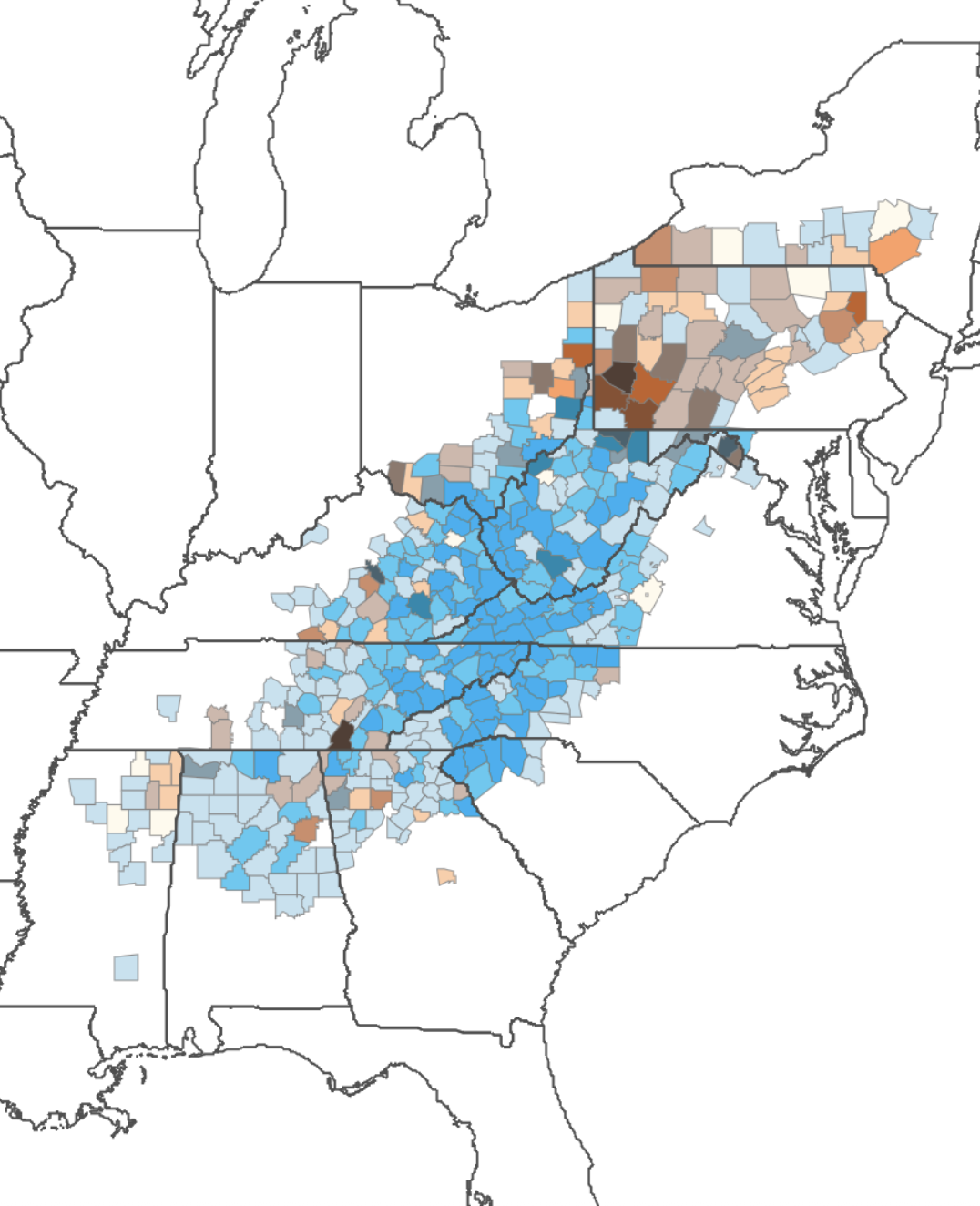
In 2024-2025, Chuck Corra of Appodlachia solicited audio submissions of 1500 folks from Appalachia pronouncing the word. He shared the data with us and we created a website investigating the data.
Brainwave Study

In this project funded by the National Science Foundation (BCS 2041264), we're looking at brain responses to different accents and comparing listeners who grew up in different areas. Participants in these studies are fitted with a cap on their head that measures electrical charges in different parts of your brain. We sync these charges to the speech that they hear, to see how the patterns of response look different when they hear real and fake words (e.g., "cat" vs. "flom") and when they hear different accents.
We are especially interested in comparing listeners who have had different dialectal exposure in their lives. Most speech perception research is usually done at universities, which means that claims about “typical” speech perception patterns are being based on a really limited set of the population. This is why we’re eager to see if we see the same sort of patterns if we collect data in different locations.
This project is a collaboration between SWVAL’s PI Dr. Abby Walker, at Virginia Tech, and Penn State’s Dr. Janet Van Hell, director of the BiLD lab. Walker is a specialist in dialectal variation, and Van Hell is a specialist in bilingualism in the brain, and so we’re joining forces to see how processing different dialects is similar/different than processing different languages.
Perceived Dialect Boundaries in SWVA

Example of a classic perceptual dialectology map, produced by a participant in Jennifer Cramer’s (2010) dissertation looking at where Kentuckians perceived different dialects.

Screenshot from a participant in our study. Instead of drawing maps, we used a “pile-sort task”, where participants are given place names and asked to make different piles depending on whether people in those towns sound similar or different.
“Perceptual dialectology” is a field of study interested in where non-linguists believe there to be dialectal variation, and what they have to say about that variation. A driving insight behind this work is that a regular person’s perception of language variation can also be as informative as the scientific analysis a linguist might do, since it helps us understand what is noticeable and comment-worthy about language.
Since there hasn’t been much work done on language in SWVA, we’ve decided to start off the SWVAL project by looking at what locals have to say about language in the area - where they think the big boundaries are, and what features of language they describe. We’ve collected data by interviewing SWVA-raised folks at Virginia Tech, but also by setting up in public spaces in Abingdon, Lebanon, Big Stone Gap and Grundy.
Our most recent data collection was at HarvestFest 2023!
The SWVAL Corpus